

The first fishermen in the Port Fairy area were the Pyipkil gunditj indigenous people who inhabited the area. They built stone and timber fishing weirs across creeks in the swampy, banksia bushland area, to trap eels and fish. Canals, vam in their language, were cut to drain swamps, and arabine, woven eel-pots, were used to trap eels. The Pyipkil gunditj people are part of the Eastern Maar people, the traditional inhabitants of the Port Fairy area.
In the early 1800s fishermen and whalers used the area. Captain James Wishart, skipper of a sealer by the name of The Fairy, gave the bay the name Port Fairy. That name was commonly used by 1835
A whaling station was set up in 1835 by John Griffiths, and a store was opened in 1839. But in 1843 the town was renamed Belfast by James Atkinson, a solicitor from Sydney who purchased a considerable amount of land in the town. He subdivided it, and built a harbour on the Moyne River. Belfast was named after Atkinson’s hometown in Ireland. The Post Office which had opened on 1843 named ‘Port Fairy’, was renamed ‘Belfast’ on 1 January 1854. It reverted to ‘Port Fairy’ when the town was officially named that by an Act of Parliament in in 1887.
After thriving on whaling in the 1830s and 1840s, whaling declined because overhunting meant not enough whales left. But the port itself grew strongly, becoming the second busiest port in Victoria, after Melbourne. It is now the home of one of the largest fishing fleets in Victoria.
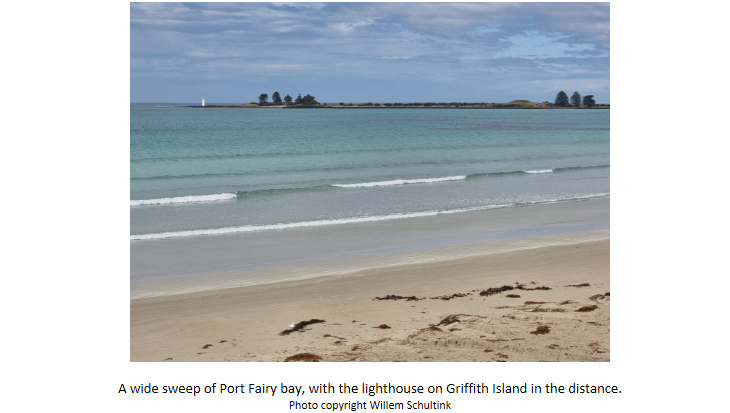
Rabbit Island was where the lighthouse was built, in 1859. Rabbit Island was later incorporated into Griffith Island, so Griffith Island is now the home of the Port Fairy lighthouse. It was built by Scottish stonemasons out of bluestone.
It was originally a manually operated light, being manned by two lighthouse keepers, and remained so until 1954. Then the light was automated with no need for lighthouse keepers.
Port Fairy was an important trading and fishing port – a key port in western Victoria. The light has made navigation of the Moyne River and its approaches much easier and safer.
Agriculture also became important. Sheep and cattle, including dairying, and vegetables were main products.
Around that time there was a lot of conflict between the settlers and the aboriginal people in the area. In 1842 27 settlers from around Port Fairy wrote to the Superintendent of the Port Fairy district, requesting the government provide security from the many ‘outrages’ committed by the natives. These were known as the ‘Eumeralla Wars’ and were part of a wider battle about resources and land use between the original inhabitants and the settlers.
The railway from Warrnambool was built in 1890, but was closed and converted to a rail trail 87 years later in 1977.
There is also pharmaceutical factory on the outskirts of Port Fairy.
It’s interesting to note that the town had a population of 2190 in 1857; by 2016 that had grown to 3340. The main industries are now tourism and fishing.
______________________________________________________
- No categories